
Acidity of Alcohols and Phenols
Complete Chapter Notes | IIT-JAM · BITSAT · GATE · CSIR-NET · TGT · PGT
1. Why Acidity? The Conjugate Base Idea
To judge how acidic a compound is, you don't just stare at its structure — you look at what happens after it loses a proton. The more stable that leftover anion (the conjugate base) is, the more willing the molecule is to let go of H⁺ in the first place. That's the whole logic.
For an alcohol R–OH, removing H⁺ gives R–O⁻, the alkoxide ion. Stability of this alkoxide tells you directly how acidic the parent alcohol is.
2. Alkoxide Ion — The Conjugate Base of Alcohols
The alkoxide ion carries a negative charge on oxygen. Oxygen handles negative charge reasonably well — better than carbon or nitrogen, but not as well as a halogen. This gives us a simple ranking of anion stability:
| Anion | Negative charge on | Stability |
|---|---|---|
| R⁻ (carbanion) | Carbon | Least stable |
| R–NH⁻ (amide) | Nitrogen | Low |
| R–O⁻ (alkoxide) | Oxygen | Moderate |
| X⁻ (halide) | Halogen | Most stable |

So alcohols sit comfortably in the middle — more acidic than amines and alkanes, less acidic than hydrogen halides. Nothing surprising, but this ordering shows up constantly in exam questions.
3. pKa Range and Comparison with Other Compounds
| Compound type | Example | Approximate pKa | Relative Acidity |
|---|---|---|---|
| Alkane | R–H | 45 – 50 | Weakest acid |
| Amine | R–NH₂ | 35 – 40 | Very weak |
| Alcohol | R–OH | 15 – 18 | Weak acid |
| Hydrogen halide | H–X | –10 to 3 | Strongest (here) |
A lower pKa = stronger acid. Always. The pKa range of 15–18 is the baseline for simple alcohols. Phenol, with resonance helping its conjugate base, drops dramatically to around 10.
4. How to Deprotonate an Alcohol
There are two practical routes, and you'll see both in synthesis problems regularly.
Method 1 — Using a Strong Base (NaH)
Sodium hydride (NaH) is the go-to reagent. The hydride ion H⁻ pulls the proton away from the alcohol, and hydrogen gas escapes as a byproduct — which conveniently drives the reaction forward.
Example: Ethanol + NaH → Sodium ethoxide + H₂↑
The gas bubbling out of solution is not just a visual cue in the lab; it's the thermodynamic driving force that makes the reaction essentially irreversible.
Method 2 — Using Reactive Metals (Li, Na, K)
Treating an alcohol directly with lithium, sodium, or potassium metal also liberates hydrogen gas and produces the alkoxide salt. The reaction is vigorous — potassium reacts most energetically of the three.
Example: R–OH + Na → R–O⁻Na⁺ + ½ H₂↑
Related Content Of Alcohol And Phenol 👇👇
5. Factors Affecting Acidity of Alcohols and Phenols
Three factors come up repeatedly — and they interact. Knowing when each one dominates is the key to solving comparison problems fast.
5.1 Resonance — The Phenol Case
This is the biggest factor, and the phenol vs. cyclohexanol example is a classic illustration.
| Compound | pKa | Reason |
|---|---|---|
| Cyclohexanol | ~18 | No resonance in conjugate base |
| Phenol | ~10 | Phenoxide ion is resonance-stabilized |
When phenol loses its proton, the negative charge on oxygen doesn't sit still. It delocalizes into the aromatic ring through five resonance structures — spreading the charge over the ring carbons at ortho and para positions. The result is a phenoxide ion that's far more stable than a simple alkoxide. Eight orders of magnitude more acidic means phenol is 10⁸ times more acidic than cyclohexanol. That's not a small difference.

The practical consequence: phenol doesn't need a strong base like NaH for deprotonation. Simple NaOH (pKa of water ~15.7) is enough, because phenol (pKa ~10) is a stronger acid than water.

5.2 Inductive Effect
Electron-withdrawing groups near the –OH group stabilize the conjugate base by pulling electron density away from the negatively charged oxygen. This lowers the negative charge concentration, stabilizes the anion, and increases acidity.
| Compound | pKa | Effect |
|---|---|---|
| Ethanol (CH₃CH₂OH) | 16.0 | Baseline |
| Trichloroethanol (CCl₃CH₂OH) | 12.2 | Three Cl atoms withdraw electrons inductively |
Three chlorine atoms make trichloroethanol 10,000 times more acidic than plain ethanol. More electron-withdrawing groups, or groups placed closer to the –OH, amplify the effect further.
Electron-donating groups (alkyl groups, –OH, –OR, –NH₂) do the opposite — they push electrons toward oxygen, destabilize the alkoxide, and reduce acidity.
5.3 Solvation Effects (Steric Effect)
This one trips students up because it seems counterintuitive at first.
| Compound | pKa | Reason |
|---|---|---|
| Ethanol | 16.0 | Ethoxide is small, well-solvated |
| tert-Butanol | 18.0 | tert-Butoxide is bulky, poorly solvated |
In solution, stability of an anion depends partly on how well solvent molecules can surround and stabilize it. The ethoxide ion is small and unhindered — solvent molecules cluster around it easily. tert-Butoxide has three methyl groups blocking access, so solvation is weaker, and the anion is less stabilized. Less stabilized conjugate base = weaker acid.
6. Acidic Strength of Phenols — Detailed Rules
Phenol's acidity relative to methanol and carboxylic acids follows a clean pattern:
Carboxylic acid > Phenol > Water > Alcohol > Alkane

Carboxylate ion is even more stable than phenoxide (symmetrical resonance, full delocalization over two oxygens), so carboxylic acids win. Alkoxide has no resonance at all, so alcohols are the weakest acids among these common functional groups.
Effect of Substituents on Phenol's Acidity
The substituent's job is to either stabilize or destabilize the phenoxide ion. The rules are:
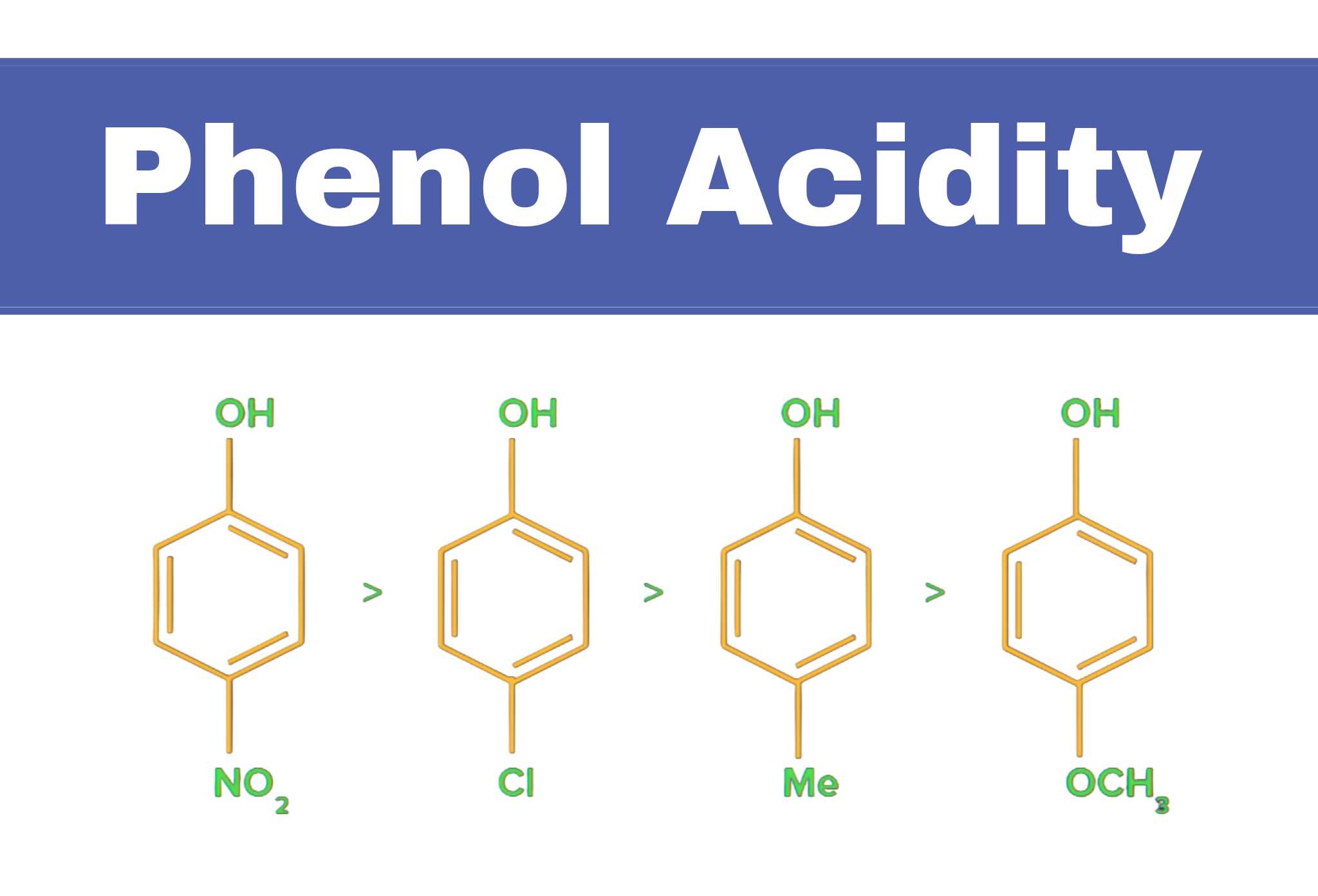
- Electron-withdrawing groups (–I or –M effect): –NO₂, –CN, –CHO, –COOH, –COOR, –SO₃H, –X, –CCl₃, –NH₃⁺ → Stabilize phenoxide → Increase acidity
- Electron-donating groups (+I or +M effect): alkyl, –OH, –OR, –NH₂, –NHR → Destabilize phenoxide → Decrease acidity
| Substituent | Effect on phenoxide | Effect on acidity |
|---|---|---|
| –NO₂ (ortho/para) | Both –I and –M, very strong withdrawal | Large increase |
| –Cl (ortho/para) | –I strong, +M weak (3rd period Cl) | Moderate increase |
| –CH₃ (ortho/para) | +I and hyperconjugation | Decrease |
| –OCH₃ (para) | +M strong, –I weak | Decrease (net) |
| –NO₂ (meta) | Only –I effective | Moderate increase |
One subtle point about chlorine: it's a third-period element, so it cannot effectively donate electrons by +M resonance into the ring. So for chloro-substituted phenols, only the –I effect is considered when comparing different positions.
Intramolecular Hydrogen Bonding
An ortho substituent capable of forming an intramolecular H-bond with the –OH group actually reduces acidity, because the proton becomes harder to release. For example, 2-nitrophenol is less acidic than 4-nitrophenol despite both having –NO₂ at comparable electronic distances, because the ortho isomer's proton is partially held back by H-bonding with the nitro group.
7. Protonating an Alkoxide Ion
Whenever a reaction produces an alkoxide ion as product, it can be converted back to the parent alcohol by treatment with an acid. The standard reagent written in textbooks is H₃O⁺, prepared by diluting HCl or H₂SO₄ in water.
R–O⁻ + H₃O⁺ → R–OH + H₂O
Technically, even weak acids like water can protonate most alkoxides — the reaction is thermodynamically favorable. But H₃O⁺ is used for efficiency and clean workup in practice.
8. Solved Examples
Given four nitrophenol isomers (–NO₂ at different positions) and plain phenol, determine the order of acidic strength.

Order: 2,4,6-trinitrophenol (picric acid) > 2,4-dinitrophenol > para-nitrophenol > ortho-nitrophenol > meta-nitrophenol > phenol
Compare 2-chlorophenol, 3-chlorophenol, 4-chlorophenol, and phenol for acidity.

Order (as per text): (B) ortho > (C) meta > (D) para > (A) phenol
Compare cresols (ortho, meta, para methylphenol) with phenol.

Order: Phenol > meta-cresol > para-cresol > ortho-cresol
For phenols with –OCH₃ at ortho, meta, para, and plain phenol:

Order: meta-methoxyphenol > ortho-methoxyphenol > phenol > para-methoxyphenol (para is weakest acid)
Five nitrophenol structures (A through E) with NO₂ at various positions and counts.

Order: E > D > C > A > B
Acidic Order Of Catechol, Resorcinol, Hydroquinone, And Phenol


9. MCQs from the Chapter (with Answer Key)
(a) CₙH₂ₙ₊₂O (b) CₙH₂ₙ₊₁O (c) CₙH₂ₙ₊₂OH (d) CₙH₂ₙOH
(a) Aldehydes (b) Ketones (c) Ethers (d) Carboxylic acids
(a) Blue (b) Green (c) Red (d) Yellow
(a) n-Butyl alcohol (b) Secondary butyl alcohol (c) Isobutyl alcohol (d) Tertiary butyl alcohol
(a) Chain isomers (b) Position isomers (c) Tautomers (d) Metamers
(a) cis eclipsed (b) Half eclipsed (c) Anti (d) Gauche
(a) Propan-1-ol (b) Prop-2-en-1-ol (c) Prop-1-en-2-ol (d) Prop-2-yn-1-ol
(a) Butan-1-ol (b) Butan-2-ol (c) 2-methyl propan-1-ol (d) 2-methyl propan-2-ol
(a) –10 to 3 (b) 35 to 40 (c) 15 to 18 (d) 45 to 50
(a) Methanol (b) Ethanol (c) Glycol (d) Glycerol
(a) Phenol's pKa is lower than water's pKa (b) Phenol's pKa is higher than water's (c) Hydroxide is a stronger base than phenoxide (d) Both (a) and (c)
(a) Resonance stabilizes CCl₃CH₂O⁻ (b) Inductive withdrawal by Cl stabilizes CCl₃CH₂O⁻ (c) Solvation effect (d) Steric effect
(a) Ethanol (b) tert-Butanol (c) Same stability (d) Cannot say
(a) NaOH (b) K₂CO₃ (c) NaH (d) Na₂CO₃
(a) H₂SO₄ (b) CaCl₂ (c) P₂O₅ (d) Benzene
(a) Ethyl alcohol + pyridine (b) Ethyl alcohol + methyl alcohol (c) Rectified spirit (d) Rectified spirit, methane naphtha, pyridine
(a) Primary benzyl alcohol (b) Secondary benzyl alcohol (c) Tertiary alcohol (d) Primary alkyl alcohol
(a) n-Butyl alcohol (b) Secondary butyl alcohol (c) Isobutyl alcohol (d) Tertiary butyl alcohol
(a) Protonation of alcohol (b) Formation of carbocation (c) Rearrangement (d) Loss of H⁺
(a) d-Isomer (b) l-Isomer (c) Optically inactive (d) Racemic mixture
1-(a) · 2-(c) · 3-(c) · 4-(b) · 5-(a) · 6-(d) · 7-(c) · 8-(b) · 9-(c) · 10-(d) · 11-(d) · 12-(b) · 13-(b) · 14-(c) · 15-(d) · 16-(d) · 17-(b) · 18-(d) · 19-(b) · 20-(d)
10. Practice Questions (25–30 Questions)
These questions are framed to match the pattern of IIT-JAM, BITSAT, GATE, CSIR-NET, TGT, and PGT examinations. Work through them before checking answers.
(a) Phenol < Cyclohexanol < Acetic acid
(b) Cyclohexanol < Phenol < Acetic acid
(c) Acetic acid < Phenol < Cyclohexanol
(d) Cyclohexanol < Acetic acid < Phenol
(a) 4.8 (b) 10.0 (c) 15.7 (d) 18.0
(a) Ethanol (b) 2-Chloroethanol (c) 2,2-Dichloroethanol (d) 2,2,2-Trichloroethanol
(a) NaCl solution (b) NaHCO₃ solution (c) NaOH solution (d) Na₂SO₄ solution
(a) 4-Nitrophenol (b) 4-Methylphenol (c) 4-Chlorophenol (d) Phenol
(a) O₂ (b) CO₂ (c) H₂ (d) N₂
(a) Inductive effect (b) Resonance stabilization of phenoxide (c) Solvation (d) Steric effect
(a) –NO₂ is more electron-withdrawing at meta
(b) Intramolecular H-bonding in 2-nitrophenol reduces proton release
(c) para position cannot conjugate with –O⁻
(d) Ortho effect always decreases acidity
(a) The oxygen in tert-butoxide is less electronegative
(b) Bulky methyl groups block solvent access to the anion
(c) tert-Butoxide is more basic so solvent avoids it
(d) Solvation only depends on charge, not size
(a) NaOH (b) H₃O⁺ (c) NaH (d) K metal
(a) Methanol < Ethanol < Isopropanol < tert-Butanol
(b) tert-Butanol < Isopropanol < Ethanol < Methanol
(c) Ethanol < Methanol < Isopropanol < tert-Butanol
(d) tert-Butanol < Ethanol < Isopropanol < Methanol
(a) R–H < R–NH₂ < R–OH < HX
(b) HX < R–OH < R–NH₂ < R–H
(c) R–OH < R–H < R–NH₂ < HX
(d) R–NH₂ < R–H < HX < R–OH
(a) Stabilize phenoxide, increase acidity
(b) Destabilize phenoxide, decrease acidity
(c) Have no effect on acidity
(d) Increase acidity only at meta position
(a) 2,4-Dinitrophenol (b) 4-Nitrophenol (c) 2,4,6-Trinitrophenol (d) 2-Nitrophenol
(a) +M effect (b) –I effect only (c) Both –I and –M (d) No effect
(a) NaOH (b) H₂O (c) H₂ gas (d) NaO
(a) Methane (b) Methylamine (c) Methanol (d) HCl
(a) More hydroxyl groups provide more inductive withdrawal from each other
(b) Larger molecular weight
(c) Greater solvation
(d) Resonance in glycerol
(a) –I effect (b) +M effect donates electrons to ortho and para positions (c) Steric effects block meta (d) None of the above
(a) 0.4 (b) 4.8 (c) 10 (d) 16
(a) III > I > II > IV (b) I > III > IV > II (c) IV > II > I > III (d) III > IV > I > II
(a) CH₃O⁻ (b) C₂H₅O⁻ (c) (CH₃)₃CO⁻ (d) (CH₃)₂CHO⁻
(a) The negative charge resides only on oxygen
(b) The negative charge is delocalized over oxygen and the ring
(c) Phenoxide is less stable than alkoxide
(d) Phenoxide cannot be stabilized by substituents
(a) Cl donates electrons by +M
(b) Cl withdraws electrons by –I, stabilizing phenoxide
(c) Cl is at para, where resonance doesn't act
(d) Cl reduces molecular weight
(a) p-Methoxyphenol; –OCH₃ stabilizes phenoxide by –I
(b) p-Nitrophenol; –NO₂ withdraws electrons, stabilizing phenoxide
(c) Both equal; substituents cancel
(d) p-Methoxyphenol; +M of –OCH₃ stabilizes the ring
(a) Stronger London dispersion forces
(b) Intermolecular hydrogen bonding in alcohols
(c) Higher molecular weight
(d) Dipole-dipole interactions only
(a) Base (b) Acid (c) Nucleophile (d) Electrophile
(a) Primary > Secondary > Tertiary
(b) Tertiary > Secondary > Primary
(c) All are equal
(d) Depends only on the electronegativity of oxygen
(a) meta is more acidic because –NO₂ exerts –M at meta
(b) para is more acidic because –NO₂ exerts both –I and –M at para
(c) Both are equally acidic
(d) meta is more acidic because of steric effects at para
(a) Cyclohexene (b) Cyclohexanone (c) Sodium cyclohexoxide + H₂ (d) Dicyclohexyl ether
P1-(b) · P2-(b) · P3-(d) · P4-(c) · P5-(b) · P6-(c) · P7-(b) · P8-(b) · P9-(b) · P10-(b)
P11-(b) · P12-(a) · P13-(b) · P14-(c) · P15-(b) · P16-(c) · P17-(a) · P18-(a) · P19-(b) · P20-(a)
P21-(a) · P22-(c) · P23-(b) · P24-(b) · P25-(b) · P26-(b) · P27-(b) · P28-(a) · P29-(b) · P30-(c)


